

Why Does My Tap Water Taste Like Chlorine?
You fill a glass at the kitchen sink and it smells a little like a swimming pool. The coffee tastes off. The shower has a faint bleach smell. So why does your water taste like chlorine, and why more on some days than others? You are not imagining it. It is one of the most common drinking-water questions we hear from homeowners on city water.
This guide explains why tap water can taste like chlorine, why the taste comes and goes, and which fixes actually help. Rochester Water Conditioning handles it the same way we handle every water question: test the water, identify the problem, then recommend the solution that matches.
Why does my water taste like chlorine?
In most homes on municipal water, the taste comes from the disinfectant your water utility adds on purpose. Public water systems treat water with chlorine or a related disinfectant called chloramine. They also keep a small amount in the water as it travels through miles of underground pipe. That leftover amount, often called a residual, helps keep the water disinfected all the way to your faucet.
So when the disinfectant makes your water taste like chlorine, it usually means it is doing its job. The trouble is that some people notice it far more than others. Coffee, tea, and plain water at room temperature tend to show it most.
Chlorine vs chloramine
Utilities choose their own disinfection method. Chlorine has the classic pool smell and can fade if water sits out. Chloramine is chlorine combined with ammonia. It lasts longer in the pipes and often smells milder, but many people can still taste it. Your utility’s annual water quality report, sometimes called a Consumer Confidence Report, lists which disinfectant it uses.
Why the chlorine taste is stronger some days
Many homeowners tell us the taste is fine for weeks and then suddenly strong. A few common reasons:
- Where you live on the system. Homes closer to a treatment plant or booster station may get water with more disinfectant than homes at the far end of the line.
- Hydrant flushing and main repairs. After flushing or a water main break, utilities may raise disinfectant levels for a while.
- Seasonal changes. Some utilities adjust treatment as water temperature changes. A few periodically switch from chloramine to chlorine for a short period, which many customers notice right away.
- Hot water. Warm water in the shower releases more of the smell, so the bathroom can smell stronger than the kitchen.
If the change is sudden and lasts more than a few days, it is worth checking your utility’s website or calling them. They can tell you whether a flushing program or treatment change is under way.
Is it chlorine, or something else?
Not every odd taste is chlorine. Before you buy anything, it helps to name the smell correctly.
- Pool or bleach smell: usually chlorine or chloramine from the city supply.
- Rotten eggs: a different problem with different causes. See why water smells like rotten eggs.
- Metallic taste with orange stains: often points to iron, which is more common on private wells.
- Chalky film and white crust: that is hardness, not chlorine. Our post on what causes white mineral buildup covers that one.
What about private wells? Most private wells are not chlorinated. However, a well that was recently shock-chlorinated to disinfect it can taste and smell like chlorine until the system is flushed. If you are on a well and the taste appears without a known cause, test the water before you treat it.
Simple checks you can do at home
- Fill a clean pitcher and leave it uncovered in the refrigerator overnight. If the taste fades, free chlorine is the likely cause. If it barely changes, your utility may use chloramine, which lingers longer.
- Compare the kitchen tap with a bathroom tap. If only one faucet tastes off, look at that faucet, its aerator, or any filter installed there.
- If you already have a filter, check when the cartridge was last changed. A carbon filter that has worn out lets the chlorine taste come back.
These checks are useful clues. They are not a full answer, especially if you have other concerns about your water.
What actually removes the chlorine taste?
If the disinfectant makes your water taste like chlorine every day, the right fix depends on where the taste bothers you and what your utility uses. Here is how the main options compare.
Reverse osmosis for drinking and cooking water
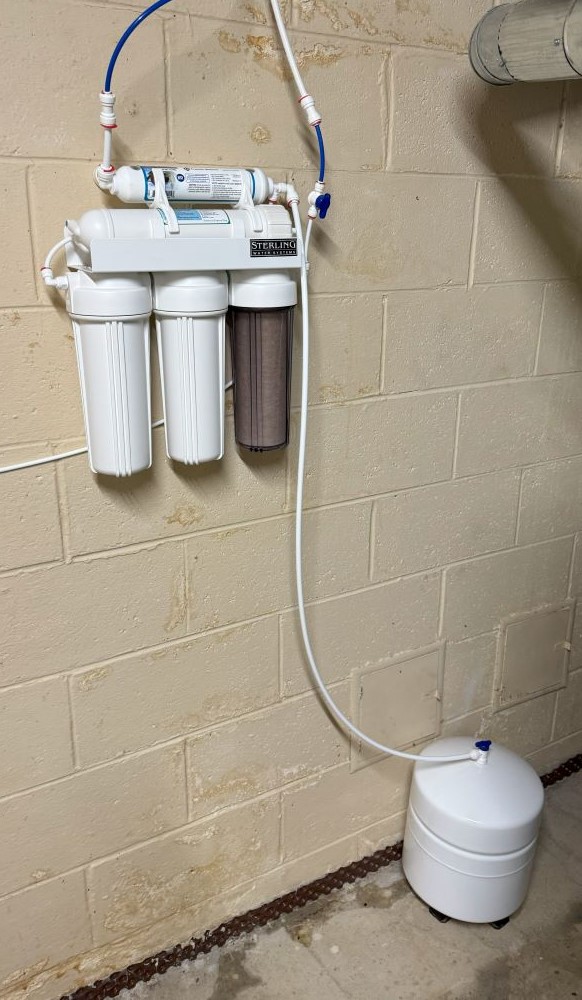
If the taste matters most in the water you drink, cook with, and use for coffee and ice, an under-sink reverse osmosis system for drinking water is usually the strongest option. RO systems use carbon pre-filters to reduce chlorine before the water reaches the membrane. That protects the membrane, and a final carbon stage polishes the taste. The result is a dedicated kitchen faucet with noticeably cleaner-tasting water.
Whole-house carbon filtration for showers and laundry
If the smell bothers you in the shower, the laundry room, and every sink, the fix needs to treat water where it enters the house. Rochester Water Conditioning sizes whole-house water filtration to the water and the household. Chloramine is harder to remove than chlorine, so the filter media has to match what your utility uses. For a side-by-side look, read whole-house filtration vs reverse osmosis. Many homes end up with both.
What a water softener will not do
A water softener removes hardness minerals such as calcium and magnesium. It is not a chlorine filter. If your home has both hard water and a chlorine taste, a softener handles the scale, while carbon filtration or RO handles the taste.
Keep the filters fresh
Carbon does not last forever. As it fills up, the chlorine taste slowly returns. When a filtered faucet starts to make the water taste like chlorine again, that is often the first sign that cartridges are due. Our guide on how often to service a reverse osmosis system walks through typical intervals. When it is time, we also handle water filter replacement for existing systems.
Help for city water homes near Rochester Hills
Rochester Water Conditioning is based in Rochester Hills and works with homes on city water and private wells. If a chlorine taste is the reason you are looking at drinking water options, these local pages are a good next step:
- Reverse osmosis in Rochester and Rochester Hills
- Reverse osmosis systems in Troy, MI
- Reverse osmosis in Bloomfield Hills
Quick FAQ
Why does my water taste like chlorine all of a sudden?
A sudden change often follows hydrant flushing, a water main repair, or a temporary treatment change by the utility. If it lasts more than a few days, contact your water utility first.
Does boiling water remove the chlorine taste?
Boiling or letting water sit out can reduce free chlorine. Chloramine is more stable and tends to stay. For a steady fix, carbon filtration or reverse osmosis works better than daily workarounds.
Will a pitcher filter fix it?
A pitcher with a carbon filter can help with chlorine taste in small amounts of water. It needs frequent cartridge changes, and it does nothing for the shower or for other water concerns.
Can you test my water for chlorine?
Yes. Our on-site water testing includes chlorine, along with hardness, iron, pH, and total dissolved solids. Those results help us recommend RO, whole-house filtration, a softener, or a combination.
Tired of the taste? Call Rochester Water Conditioning
Does your water taste like chlorine more than you would like? That taste is usually a sign your utility is disinfecting the water, not a reason to give up on your tap. Test the water, confirm what is causing the taste, and then choose the fix that matches. That might be RO at the kitchen sink, whole-house filtration, or simply a fresh filter. Call us at (248) 651-5238 or contact us online to schedule a free water test.